
Security Equipment Required for Metro Stations
Layered Screening, Passenger Flow Protection & Urban Transit Infrastructure Security. Metro rail systems operate under a unique security challenge. Passenger volumes during peak hours can multiply rapidly. Security systems must operate without disrupting commuter flow.
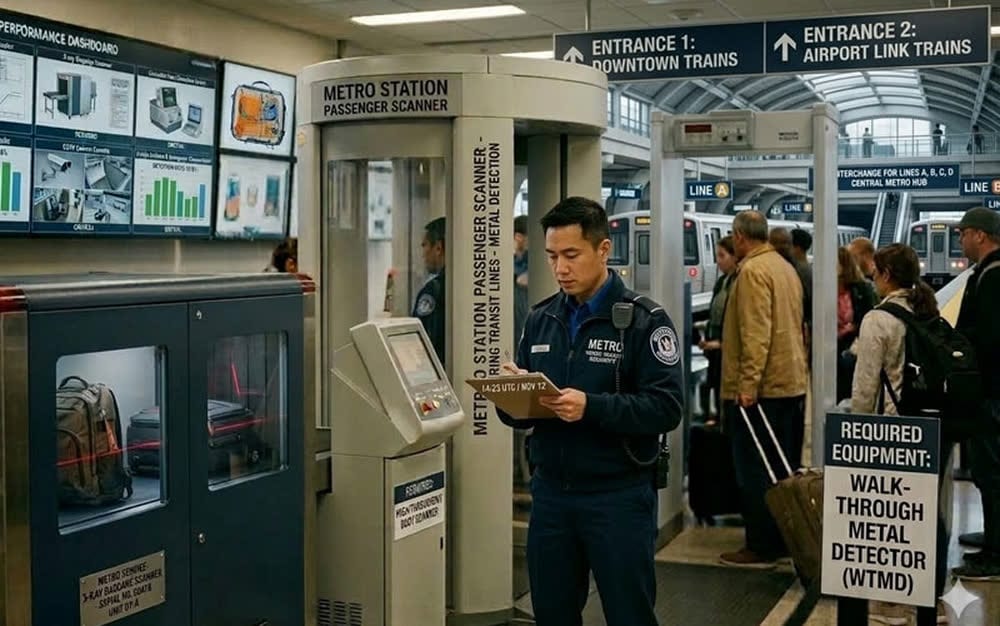
Security Equipment Required for Metro Stations
Metro rail systems operate under a unique security challenge. Passenger volumes during peak hours can multiply rapidly. Security systems must operate without disrupting commuter flow.
This guide outlines the structured security equipment required for metro station infrastructure.
Understanding Metro Security Zones
Metro stations typically include several zones, each requiring specific security measures:
Core Security Equipment
Walk Through Metal Detectors (WTMD)
Purpose: Primary passenger screening at entry points.
- Installed at station entry gates
- Detect metallic threats
- High throughput capability
- Low false alarm rate
Hand Held Metal Detectors (HHMD)
Purpose: Secondary screening.
- Random checks
- Alarm verification
- Event reinforcement
- High-alert situations
X Ray Baggage Inspection Systems
Purpose: Screening of carry bags and luggage.
- Installed at selected stations
- Material discrimination
- High conveyor speed
- Compact footprint
Explosive Detection Equipment
Purpose: Chemical detection layer.
- Explosive Trace Detection (ETD)
- Portable explosive detection units
- Secondary verification during alerts
- Suspicious bag sampling
Surveillance Systems
Purpose: Crowd and platform monitoring.
- CCTV networks
- AI-assisted monitoring
- Central command room integration
- Incident documentation
Support & Containment Systems
Anti-Drone Monitoring (Where Applicable)
Provides airspace monitoring layer in high-sensitivity metropolitan zones:
- Drone detection systems
- Perimeter radar
Access Control Systems
For restricted areas like Control rooms and Electrical rooms:
- Biometric access
- Metal detection
- Electronic entry logging
Emergency Containment Equipment
Ensures preparedness without disrupting daily operations:
- Emergency response kits
- Containment equipment
- Evacuation communication systems
Radiation Monitoring (Selective Deployment)
Supports infrastructure-level protection in high-sensitivity zones:
- Radiation survey meters
- Portable monitoring devices
Throughput & Layered Security Model
Throughput Considerations — metro security must be optimized for rapid flow:
- Minimize congestion and avoid long queues
- Maintain commuter convenience
- Handle peak-hour surges effectively
Layered Security Configuration:
- Primary entry metal detection
- Secondary handheld screening
- Baggage inspection (selected stations)
- Surveillance coverage & Command monitoring
- Emergency containment readiness
Integration, Maintenance & Scalability
Integration with Central Command — security equipment must support system-wide integration:
- Centralized monitoring
- Real-time alert management
- Incident escalation protocols
Maintenance & Scalability:
- Preventive maintenance cycles
- Calibration schedules
- Modular station integration
- Software and technology upgrades
Request Metro Station Security Assessment
Regulatory Considerations & Planning Pitfalls
Metro security equipment must align with:
- Urban transit security frameworks
- Government safety standards
- Public safety and operational guidelines
Common Mistakes in Planning:
- Over-specifying without throughput study
- Ignoring peak commuter load dynamics
- Deploying airport-grade screening without adaptation
- Neglecting lifecycle maintenance
Frequently asked questions
Q1What security equipment is required for metro stations?+
Metal detectors, X ray systems, surveillance, and layered screening depending on station risk profile.
Q2Are CT scanners required in metro stations?+
Typically not required unless the station is within a high-risk infrastructure zone.
Q3Do metro stations use explosive trace detection?+
ETD systems are used selectively for secondary screening of suspicious items.
Q4How do metro stations manage peak-hour screening?+
By utilizing high-throughput metal detectors and optimizing station queue design.
Q5Is baggage screening mandatory in metro stations?+
Baggage screening requirements depend on regional regulations and station risk assessment.
Q6Can metro security systems be integrated centrally?+
Yes. Modern security systems are designed to integrate with central station command centers.
Q7Is lifecycle planning important for metro security equipment?+
Yes. Continuous daily operation requires structured preventive maintenance and calibration.
Q8Can security systems scale with metro expansion?+
Yes, provided modular systems are selected during the initial procurement phase.
Get Metro Station Security Equipment Proposal
Connect with our transit security team for structured screening solutions designed for high-throughput metro station environments.
Explore further
Industry Pages
Use Pages
Product Pages
Service & Location Pages
- Security Risk Assessment & System Planning→
- Custom Security Solution Integration→
- Security Equipment Installation & Integration Services→
- Annual Maintenance Contract for Security Equipment→
- Security Equipment Calibration & Testing→
- Lifecycle Management for Detection Equipment→
- Security Equipment Supplier in Mumbai→
- Security Systems Supplier in Delhi NCR→
- Security Equipment Provider in Gujarat→
Speak to Transit Security Specialist
Connect with our transit security team for structured screening solutions designed for high-throughput metro station environments.