
How Explosive Trace Detection Systems Work
Principles, Detection Mechanisms & Operational Role in Security Infrastructure. Explosive threats are not always visible. Modern security environments require systems capable of identifying microscopic traces of explosive materials through advanced chemical analysis before they become a larger risk.
What Is Explosive Trace Detection?
Explosive Trace Detection (ETD) refers to technology designed to detect extremely small quantities of explosive material residue.
Unlike imaging systems such as X ray or CT scanners, ETD systems do not rely on visual detection. They analyze microscopic chemical particles collected from surfaces, baggage, cargo, or individuals. The detection is based on chemical signature analysis rather than object shape.
Understanding how ETD systems work helps infrastructure operators select appropriate screening layers and integrate them effectively within broader security architecture.
Core Operating Principle
Most modern ETD systems operate using:
- Ion Mobility Spectrometry (IMS)
- Mass spectrometry-based detection
- Chemical signature comparison algorithms
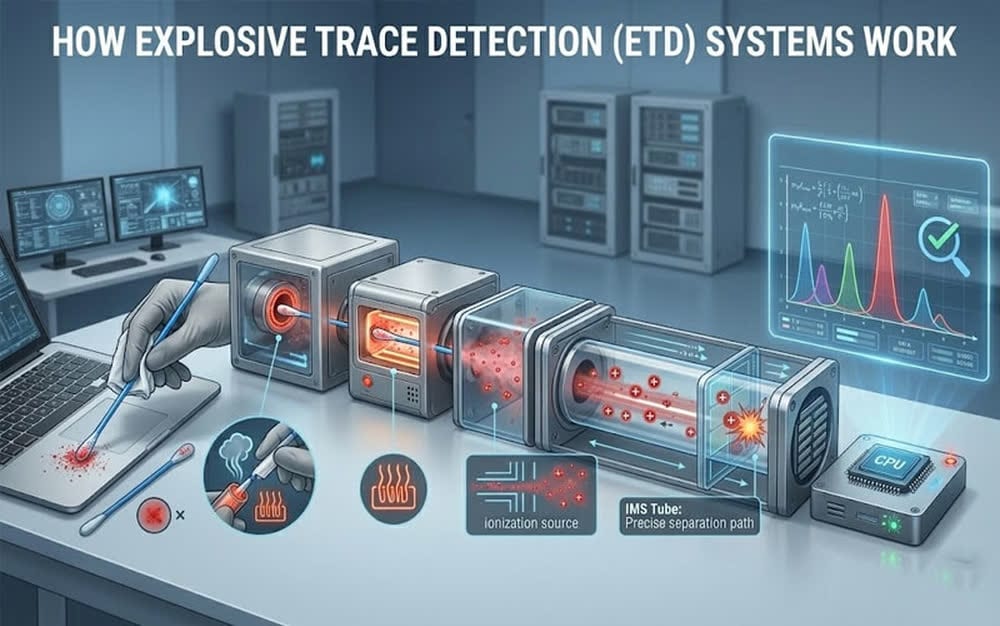
The goal is to identify specific molecular patterns associated with explosive compounds. The system compares collected trace samples against a built-in database of known explosive signatures.
Step-by-Step Operational Overview
Sample Collection
Microscopic residue particles are collected via swabs, air sampling, or vapor modules from:
- Passenger baggage & Electronic devices
- Cargo containers & Vehicle interiors
- Suspicious surfaces
Sample Introduction
The collected sample enters the detection chamber where particles are vaporized or ionized for molecular analysis.
Ionization & Separation
Molecules pass through an electric field. Compounds move at different speeds based on molecular weight and structure, creating a unique pattern.
Signature Comparison
The detected ion pattern is compared against stored explosive compound libraries and regulatory-approved standards.
Alarm & Notification
If thresholds are exceeded, audible and visual alerts trigger secondary screening protocols.
Sensitivity & Explosive Materials Detected
Sensitivity levels are calibrated to:
- Reduce false positives
- Maintain detection reliability
- Adapt to environmental factors
- Align with operational throughput
Materials Detected:
- Military-grade explosives
- Commercial explosive compounds
- Improvised explosive material residues
Where ETD Systems Are Used
Aviation Security
Secondary baggage screening, random passenger screening, airside security, and cargo inspection.
Border & Customs
Cargo container sampling, vehicle inspection, and suspicious package verification.
Metro & Railway
Applied in random bag checks and reinforcement during high-risk alert periods.
Industrial Facilities
Access control validation and suspicious material detection in high-security zones.
ETD vs Imaging Systems
Imaging systems detect shapes and density; ETD detects chemical signatures. Layered deployment ensures comprehensive protection:
Each system addresses a different threat vector.
Maintenance & Operational Considerations
Environmental Influences:
- Temperature & Humidity
- Dust concentration
- Surface contamination
- Throughput intensity
Maintenance Requirements:
- Sensor validation
- Consumable replacement
- Software updates
- Threshold recalibration
- Performance benchmarking
Modern systems incorporate advanced filtering and sensitivity tuning to reduce false alarms while maintaining security integrity.
Request Explosive Detection Technology Consultation
Frequently asked questions
Q1What is an Explosive Trace Detection system?+
It is a chemical analysis system that detects microscopic explosive residue particles rather than physical object shapes.
Q2Can ETD systems detect concealed explosives directly?+
They detect residue traces left on surfaces or baggage, not the physical concealed explosive objects themselves.
Q3Are ETD systems used in airports?+
Yes. They are widely deployed in aviation security for secondary screening and random checks.
Q4How sensitive are ETD systems?+
They are extremely sensitive, capable of detecting nanogram-level quantities of explosive residue.
Q5Do ETD systems require calibration?+
Yes. Regular calibration ensures detection accuracy and aligns the system with regulatory standards.
Q6Can ETD systems reduce false alarms?+
Yes. Modern systems use advanced filtering algorithms and sensitivity threshold tuning to minimize nuisance alerts.
Q7Are ETD systems used in cargo inspection?+
Yes. They are commonly used to sample cargo packaging and containers for illicit material traces.
Q8Can ETD systems be integrated with other screening systems?+
Yes. They function as a critical chemical detection layer within a coordinated security architecture.
Request Consultation on Explosive Detection Systems
Connect with our technical team to discuss structured chemical analysis and layered security deployment for your infrastructure.
Explore further
Industry Pages
Use Pages
Product Pages
Speak to Explosive Detection Specialist
Connect with our technical team to discuss structured chemical analysis and layered security deployment for your infrastructure.