
Understanding Chemical Detection vs Vapor Detection vs Advanced Imaging in Modern Security Infrastructure. Security screening systems are often grouped together, but not all detection technologies operate in the same way. ETD, EVD, and CT scanners serve different roles within layered security architecture.
Understanding their differences helps airport operators, border agencies, industrial security heads, and infrastructure planners design balanced screening systems. Each technology addresses a specific threat vector. They are complementary — not interchangeable.
ETD → Detects microscopic explosive residue particles
EVD → Detects explosive vapors in the surrounding air
CT Scanner → Produces advanced 3D imaging of baggage or cargo
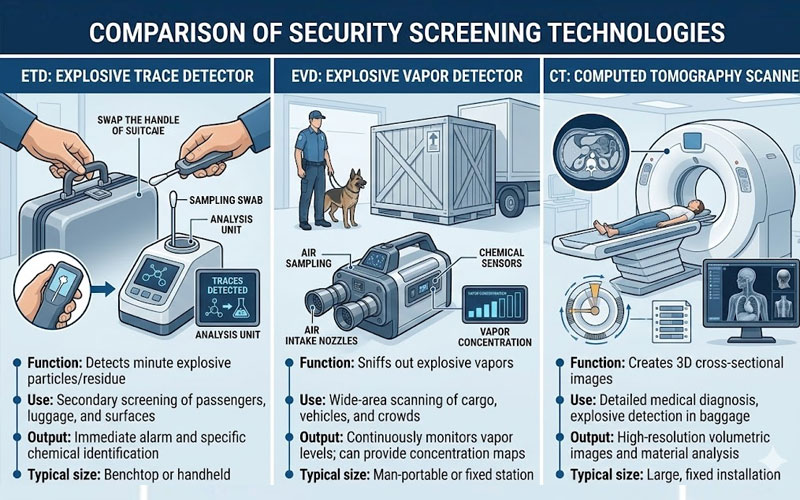
Microscopic explosive residue particles left behind after handling materials. ETD systems detect trace contamination on baggage surfaces, electronic devices, vehicle interiors, and cargo packaging.
1. Sample is collected using a swab or air sampler.
2. Particles are analyzed using chemical detection technology.
3. System compares chemical signature to an explosive library.
4. Alert generated if match is detected.
Explosive vapors released into the air. EVD systems focus on airborne molecules rather than surface particles, providing a non-contact detection capability.
1. Air is continuously sampled from the environment.
2. Vapor molecules are analyzed chemically.
3. System compares detected vapors to known signatures.
4. Alarm is generated if thresholds are exceeded.
Physical object characteristics: density, shape, mass distribution, and material composition. Relies on advanced imaging rather than chemical analysis.
1. Baggage passes through a rotating X-ray system.
2. Multiple cross-sectional images are captured.
3. 3D image reconstruction is generated.
4. Software analyzes material properties and flags suspicious items.
| Feature | ETD | EVD | CT Scanner |
|---|---|---|---|
| Detection Type | Chemical residue | Airborne vapor | Imaging & material analysis |
| Contact Required | Yes (swab/sampling) | No (air sampling) | No (baggage scanning) |
| Primary Use | Secondary screening | Atmospheric monitoring | Primary baggage screening |
| Detects Object Shape | No | No | Yes |
| Throughput | Moderate | Continuous | High |
Primary: CT Scanner | Secondary: ETD | Air Quality: EVD (where required).
Cargo: CT / High-energy scanners | Secondary: ETD | Confined Areas: EVD.
Random Inspection: ETD | Primary (High Risk): X-ray or CT.
Access Control: ETD | Zone Monitoring: EVD | Vehicles: Imaging systems.
Modern infrastructure requires combining these technologies with Walk Through Metal Detectors, Vehicle Inspection, and Radiation Monitoring to reduce reliance on any single system.
Connect with our specialized team to discuss advanced chemical and imaging detection layers for your infrastructure.
📞 Request Consultation