
Detection, Monitoring & Airspace Risk Mitigation for High-Sensitivity Facilities. Unmanned aerial systems (UAS), commonly referred to as drones, have introduced new security challenges for critical infrastructure environments. Anti-drone technology provides structured airspace monitoring and controlled mitigation mechanisms to protect sensitive infrastructure.
Unmanned aerial systems (UAS), commonly referred to as drones, have introduced new security challenges for critical infrastructure environments.
Airports, oil & gas facilities, border checkpoints, government complexes, industrial plants, metro networks, and high-footfall venues face risks associated with unauthorized drone activity.
Anti-drone technology provides structured airspace monitoring and controlled mitigation mechanisms to protect sensitive infrastructure.
This guide explains how anti-drone systems work, the technologies involved, and how they integrate within layered critical infrastructure security frameworks.
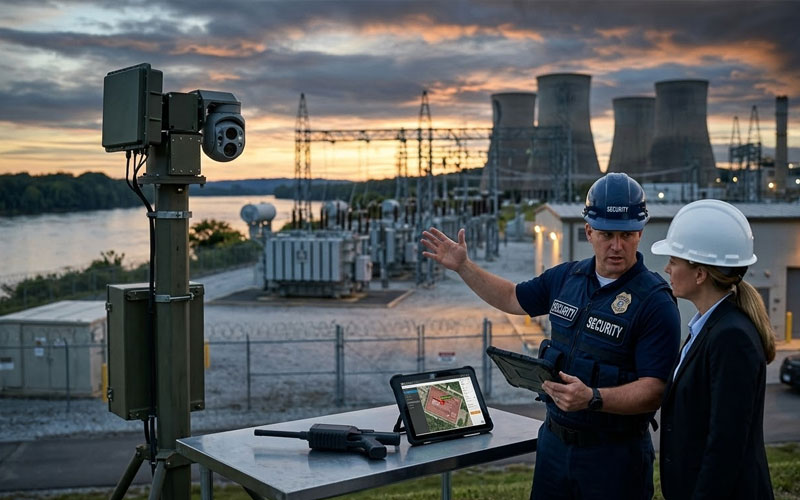
Critical infrastructure facilities are vulnerable to:
Even small drones can disrupt airport operations or create safety concerns in industrial zones. Airspace protection has become a formal part of modern infrastructure security planning.
Anti-drone systems are designed to:
Anti-drone systems operate within legal and regulatory frameworks governing airspace management.
Radio Frequency (RF) Detection
Monitors communication signals between drone and controller. Identifies: Drone control frequency, Communication pattern, Signal origin. Effective for early detection.
Radar-Based Detection
Detects: Flying objects in protected airspace, Flight trajectory, Speed and altitude. Suitable for wide-area monitoring.
Electro-Optical / Infrared (EO/IR) Systems
Provide: Visual confirmation, Thermal tracking, Day & night monitoring. Enhances verification capability.
Acoustic Sensors
Detect drone sound signatures. Used in layered detection environments.
After detection, the system:
Tracking data is sent to command center.
Anti-drone systems integrate with:
Real-time alerts enable coordinated response.
Mitigation technologies may include:
Mitigation deployment is governed by national regulations and authorized agencies.
Prevents: Runway interference, Flight path disruption, Airside intrusion. Anti-drone protection is critical in aviation zones.
Prevents: Industrial surveillance, Hazardous zone intrusion, Perimeter breaches. Airspace monitoring protects high-risk zones.
Prevents: Cross-border surveillance, Illicit transport via drone, Airspace infiltration. Drone detection complements ground monitoring.
Prevents: Station surveillance, Operational disruption, Crowd safety risk. High-density environments require proactive monitoring.
Protects: Sensitive buildings, Data centers, Power plants, Defence installations. Airspace security is part of perimeter strategy.
Effective anti-drone architecture may include:
Traditional surveillance monitors ground-level threats. Anti-drone systems monitor airspace. They complement each other rather than replace one another.
Performance depends on: Urban signal interference, Weather conditions, Physical obstructions, Airspace congestion, Regulatory constraints. System design must adapt to operational environment.
Anti-drone systems integrate with: Perimeter security, Surveillance networks, Access control systems, Vehicle inspection systems, Emergency response protocols. Integration enhances coordinated response.
Lifecycle management ensures reliable detection.
Connect with our specialists for integrated anti-drone and monitoring solutions for high-sensitivity facilities.
📞 Request Consultation